

Image description: Intersectionality Unleashed title graphic. Gray background with blue, green, and orange diagonal stripes on the left and right hand sides. In the middle, the Disability Network logo and the words “Intersectionality Unleashed: Amplifying Diverse Voices.” Under those words, an illustrated group of eleven people with various disabilities are gathered together in conversation.
Suicide Awareness Month
Written by Kari Havenaar, MA & Anna Dusbiber, LMSW
September is Suicide Prevention Month, and at DNWML we have gathered resources to share with the community that can assist with mental health. Mental health is not always discussed in conversations surrounding disability, and we are here to bridge that gap. Disability is self-defined by the individual experiencing it and that is not just limited to physical disabilities. This blog’s resources are to help individuals access services in a mental health crisis.
Just know that you aren’t alone in what you are experiencing, and if you or a loved one you know needs emergency support, please call 911. If you are looking to be connected to resources other than the ones provided below, please call us at (734) 971-0277. Disability Network provides information and referral to outside organizations that do emergency services, and mental health support. To assist in bridging a gap with suicide prevention month, there are some staff testimonials below to read about why Mental Health is important, and why DNWML is taking it seriously.
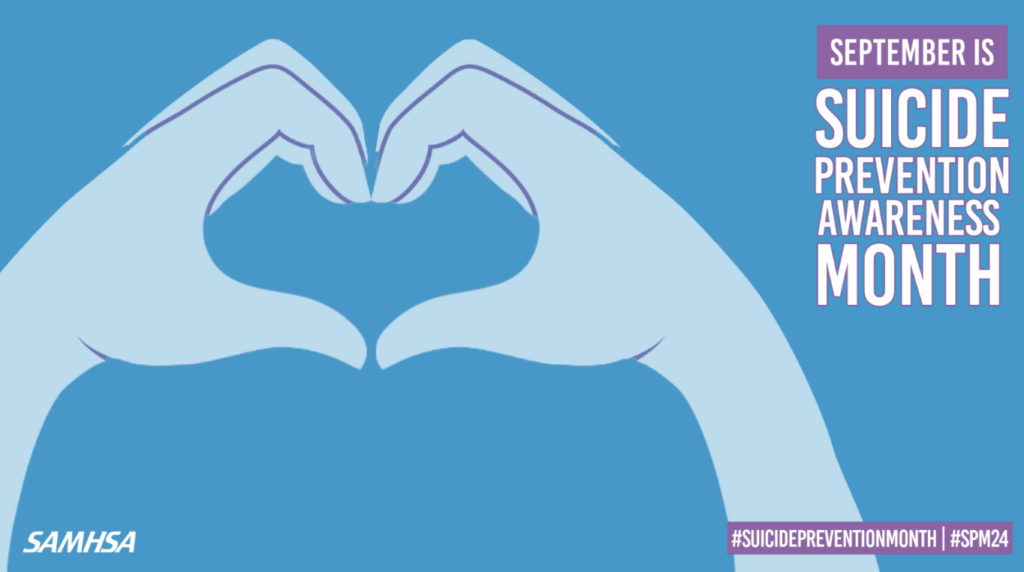
Image Description: This is a blue image with two hands coming together to create a heart. The hands are a lighter blue than the background. This campaign image is from SAMHSA, which is a suicide awareness organization.
Staff Testimonials
“Mental health care is incredibly important to me because we never truly know what someone may be going through. I have loved ones who struggle with their mental health, and I can’t imagine the world without them. Let’s prioritize taking care of ourselves and supporting each other.” -Krystina
“We’ve been taught to think about mental health and physical health as totally different even though they are very much connected. I have gotten into vicious cycles when my chronic illness flares up and I have less energy to spare, which makes me feel even more isolated and overwhelmed. When that happens, I try to show my body and my mind that I care about them like I would a close friend – for example, by spending some time outside and taking in all the living things around me. We also need to let people we trust know if we are struggling, which is especially hard if we are used to being constantly misunderstood or undervalued by others because of our disability. But if we carry all our stress inside ourselves, it creates more strain for our minds and bodies.” -Eliot
“Self-care for me means nourishing the connections between my mind and body. This enables me to listen and respond to those connections and give my mind and body what it needs during the day and throughout the week. I achieve this by engaging in a routine of exercise, mindful eating, and setting boundaries. One way of implementing this is by identifying ways in which I can preserve my time that is applicable to my self-care and personal life. I have worked hard to navigate a work life integration in ways that are positive to my relationship with mind and body so that I can show up as the most unapologetic version of myself.” -Anna
“Due to a long history of non-disabled society infantilizing and dehumanizing disabled people, for most of my lifetime the topic of mental health and the mental health conditions with which we may live were often taboo topics. Many disabled people were understandably reluctant to be seen as weak, self-pitying, or fragile. In addition to the demand to “overcome” our disabilities with a smile, we also have had to contend with the ableism of misconceptions about mental health conditions among our own communities. The pressure to be a supercrip is real, and that representation of disability remains alive and well in our culture. Luckily, many of these barriers have begun to shift in the last decade, and I have noticed that within the disability community, it is more accepted to discuss mental health challenges more openly and honestly. Unfortunately, there are still negative attitudes among disabled and non-disabled alike when it comes to being vulnerable about one’s mental health experiences. Disabled people often face a greater risk of depression, anxiety, and other mental health and physical health conditions because of the daily stressors of living in an environment and society that marginalizes our bodies and that is not designed or built for diverse bodily experiences. In addition to these environmental and social barriers, we can daily deal with physical conditions that cause physical pain, fatigue, or simply increased effort when compared with non-disabled peers. All this daily stress, for some, can lead to impacts on our mental health. I feel it is important to give ourselves the grace to recognize when we are struggling and to seek support that is trauma and disability informed. As a community, we must work for increased access to mental and physical health care that is fully aware and inclusive of disability, and to continue to openly advocate within the disability community for enhanced understanding, research, education and acceptance of mental health as a key component of all our lives as complete human beings.” -Renee
Resources:
Self-Care Is For Everyone — mental health clothing, art & resources (selfcareisforeveryone.com)
988 Lifeline – If you need emotional support, reach out to the national mental health hotline: 988.
The Trevor Project – Suicide Prevention for LGBTQ+ Young People
Alliance of Hope For Suicide Loss Survivors | Home
Need Crisis Support? | Washtenaw County, MI
We’re Here For You – Monroe Community Mental Health Authority (monroecmha.org)
2023 Livingston County Community.pdf (mclaren.org)
Crisis and Suicide Prevention Hotlines (henryford.com)
Mental Health Facilities in Livingston County, MI (mentalhealthclinics.org)
Mental Health Support Groups – NAMI Washtenaw County (namiwc.org)